Is Projection Dead?
Its role has changed, but projection remains useful where scale, shape and interaction call for a different approach.
No. Projection has lost ground in some familiar settings over the past 20 years, but it remains an important technology across the AV and experiential sectors. Its place has changed as flat panels and LED have improved. The question now is where projection still offers the right combination of cost, resolution, shape and interaction.
Why projection use has declined
The short answer is cost. Projectors, lenses, installation and ongoing maintenance can make a projection system more involved and expensive than a flat panel, particularly in a standard meeting room. As flat panels became larger, better and more affordable, they became the straightforward choice for many everyday displays.
Brightness has also shifted the balance. LED displays can produce bright, high-impact images at large sizes, and have taken projection’s former lead in many large-format applications. For a large, flat display in a bright environment, LED may be the better fit.
Where projection still makes sense
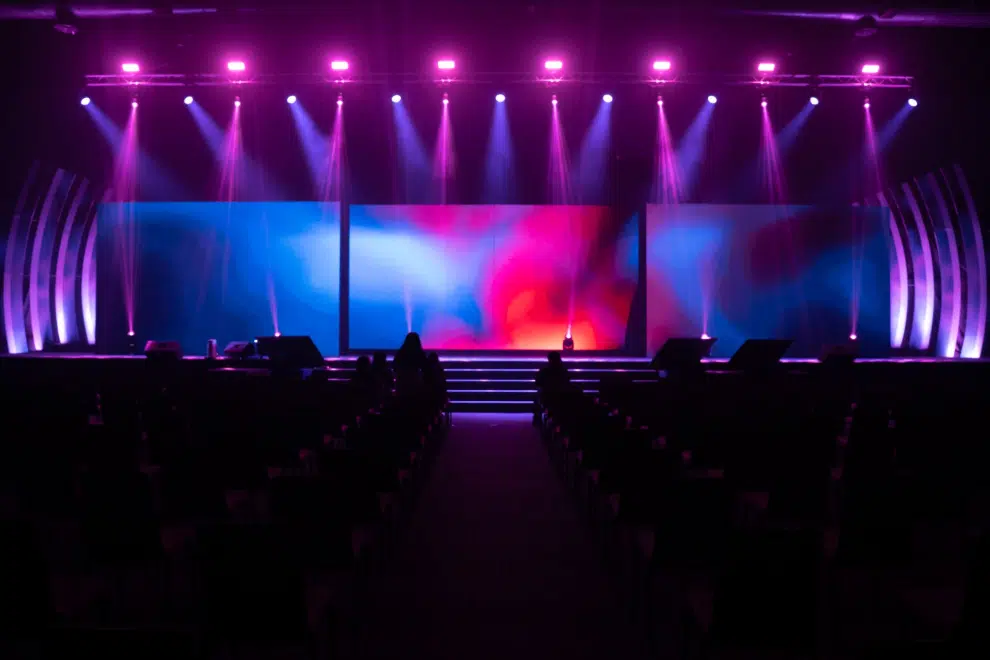
Cost depends on the size and type of display. A large projected image can often be created with a single projector and a large canvas. At some sizes and specifications, that can be simpler and more economical than assembling a display from many LED panels. The right comparison includes the projector, screen, installation, operating conditions and maintenance over the life of the system.
Resolution is another consideration. LED pixel pitch sets the number of pixels across a display. With a 1.86 mm pitch, a panel needs to be about 7.6 metres wide to provide 4,096 pixels across. A suitable native 4K projector can deliver a 4K image on a smaller surface, although the final result also depends on the projector, lens, focus and viewing conditions
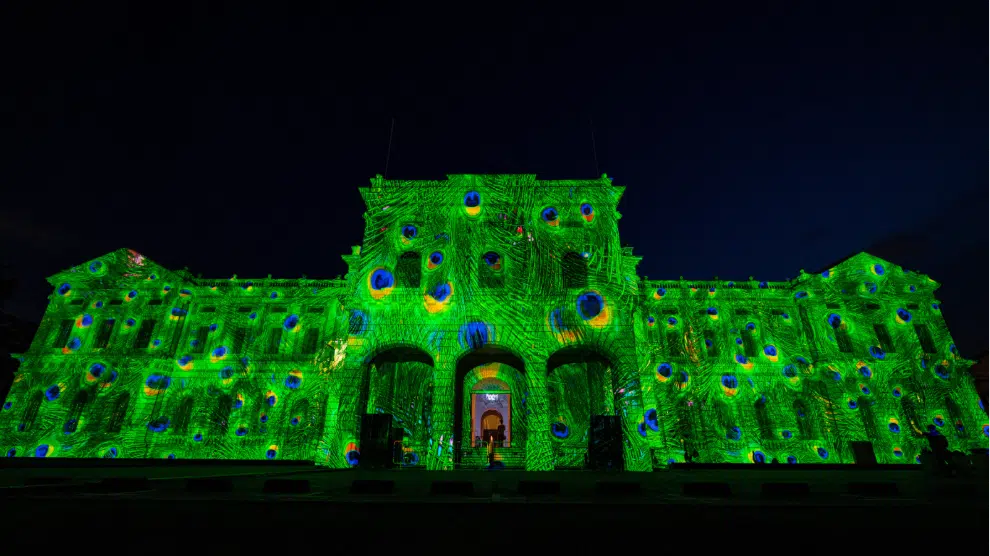
Projection mapping can also cover surfaces that are difficult to build from flat panels. Content can be warped and calibrated to follow a sphere or another complex shape. This is one reason Pufferfish uses projection for smaller spheres and LED for larger surfaces: each technology suits a different scale and set of engineering trade-offs.
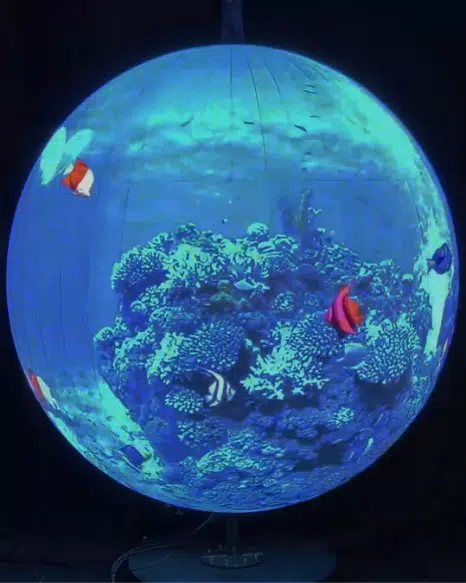
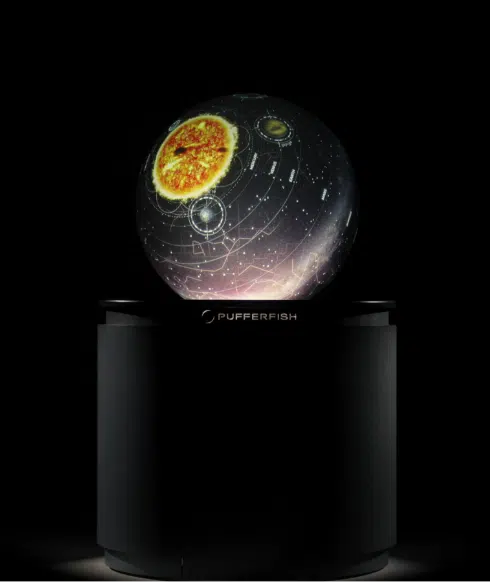
Touch adds another difference. Capacitive touch is well suited to flat surfaces and can be adapted to some surfaces curved in one direction. A sphere curves in two directions, making consistent capacitive touch much harder. Projection-based systems can use vision-based touch sensing across the spherical surface; applying that approach to an LED sphere is much more difficult.
[insert two images of a finger touching a sphere to illustrated touch]
A different kind of simplicity
Projection has its own demands: lens choice, alignment, calibration, brightness and maintenance all matter. It is not automatically simpler in every installation. But the display surface can be continuous, without the joins, separate panel connections and individual LED elements found in a modular LED display. That also avoids the specific maintenance issue of dead or mismatched LEDs within individual panels. Projected images still contain pixels, of course, and the projector itself can require maintenance.
There is no single display technology that wins everywhere. A meeting-room screen, a large public display and an interactive globe have different requirements. The useful questions are: What shape is the surface? How large and bright must the image be? How will people interact with it? How will the system be installed and maintained?
Projection is not dead. Its role has moved towards applications where the surface, geometry and interaction matter as much as the image itself. For spherical displays that people can touch and explore, projection remains a compelling way to bring the world to life.
Tom Frame,
CTO Pufferfish Displays Ltd
tomframe@pufferfishdisplays.com
Pufferfish © 2026